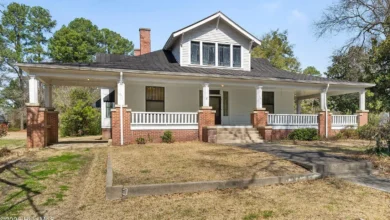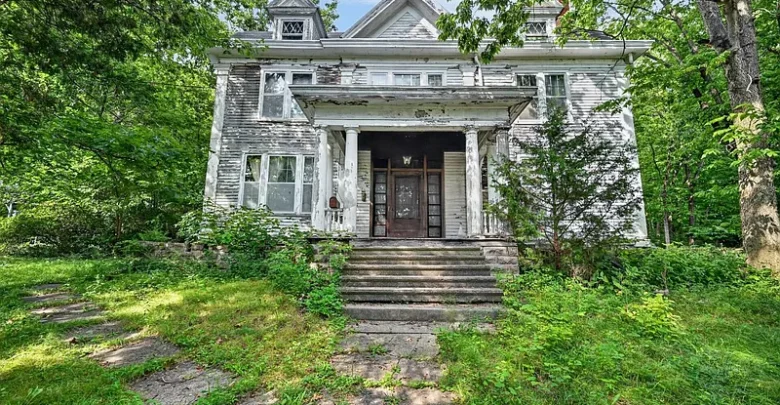
A stately 1907 historic home on nearly an acre in Aurora, Indiana, with tall ceilings, original craftsmanship, and mature trees, ready for full restoration and listed at $84,900.
Under $85,000 for a 3,685 square foot historic home on nearly an acre.
That number alone explains why the listing opens with the words “Investors wanted.”
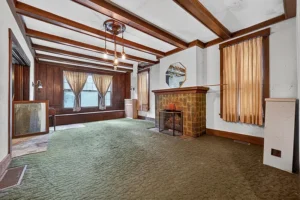
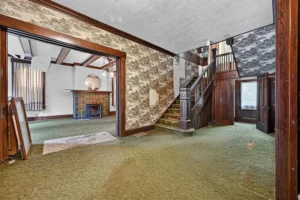
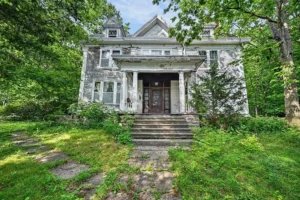
Built in 1907, this home at 336 Sunnyside Avenue in Aurora, Indiana, still carries the character of its era: spacious rooms, tall ceilings, original craftsmanship, and architectural details that are rarely built today.
It sits on 0.96 acres surrounded by mature trees, creating a private, park-like setting just minutes from downtown Aurora and the Ohio River.
It also clearly needs work. The listing describes it as a property ready for someone with vision to restore it to its former glory.
Below, we walk through what this home offers, what a restoration could involve, how to think about the numbers, and the questions any buyer should ask before making an offer.
Property Overview
- Address: 336 Sunnyside Ave, Aurora, IN 47001
- List price: $84,900
- Bedrooms: 5
- Bathrooms: listed as 2 in the property data, described as 1.5 in the listing remarks
- Living area: 3,685 square feet
- Year built: 1907
- Lot size: 0.96 acres
- Setting: mature trees, private, park-like
- Features: tall ceilings, spacious rooms, original craftsmanship and architectural details
- Condition: restoration project, marketed to investors
The Location: Aurora, Indiana
Aurora is a historic river town in Dearborn County, in the southeastern corner of Indiana along the Ohio River.
Like many Ohio River towns, it grew during the 1800s when river trade brought prosperity, and that history is still visible in its older homes and downtown buildings.
Aurora is also within commuting distance of the Cincinnati area, which makes it attractive for buyers who want small-town living with access to a larger metro region.
The listing notes the home is just minutes from downtown Aurora, local restaurants, shopping, schools, and the Ohio River.
The Setting: Nearly an Acre of Mature Trees
The home sits on 0.96 acres.
That is a generous lot for an in-town historic property. Many homes of this era sit on narrow city lots, so nearly a full acre is a real advantage.
Mature trees surround the property, providing shade, privacy, and a park-like feel.
Large old trees also need attention. Buyers should have an arborist look at any trees close to the house, since dead or damaged limbs can threaten the roof and power lines.
The Historic Character
Homes built in the early 1900s were often constructed with solid materials and careful craftsmanship.
Old-growth lumber, plaster walls, detailed trim, and tall windows were common. Many of these elements are expensive or impossible to replicate today.
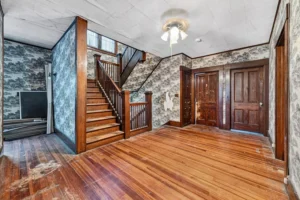
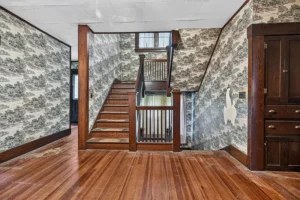
The listing highlights original craftsmanship and beautiful architectural details. Buyers should take note of exactly what remains, such as woodwork, staircases, doors, hardware, fireplaces, and windows, since these features drive the value of a quality restoration.
The Tall Ceilings
Tall ceilings are one of the hallmarks of homes from this period.
Before air conditioning, high ceilings helped keep rooms cooler in summer. Today they make rooms feel open, airy, and elegant.
They also offer practical benefits during renovation, such as room to run new ductwork or wiring above a lowered ceiling in select areas if needed.
The Spacious Rooms
The listing describes the rooms as spacious.
Large rooms give a restorer flexibility. They can accommodate an updated kitchen, a larger bathroom, or a modern layout change while keeping the home’s historic feel.
The Bedrooms
The home offers five bedrooms.
That is a strong count for a family home or a rental property. Buyers should confirm room sizes and closet space, since many homes of this age were built with small closets or none at all.
The Bathrooms
The property data lists two bathrooms, while the listing description mentions one and a half.
Buyers should confirm the actual count during a showing.
Either way, a five-bedroom home with limited bathrooms is a clear opportunity. Adding or expanding a full bathroom is often one of the most valuable upgrades in a restoration, both for daily living and resale.
The Kitchen
The listing does not describe the kitchen.
In a restoration project, buyers should expect the kitchen may need a full update. The good news is that a large historic home usually has room to create a spacious, modern kitchen while preserving character elsewhere.
The Scope of the Work
The listing makes it clear this home needs a buyer with vision.
For a home built in 1907, a full restoration may involve some or all of the following:
- Roof repair or replacement
- Foundation and structural repairs
- Full electrical updates, possibly removing knob-and-tube wiring
- New plumbing supply and drain lines
- New heating and cooling systems
- Window restoration or replacement
- Plaster repair
- Kitchen and bathroom updates
- Insulation and energy improvements
- Exterior paint, porch, and trim repairs
Getting a clear picture of these needs before buying is the most important step.
Roof
The roof’s age and condition are not mentioned.
On a large historic home, roof replacement can be one of the biggest expenses. A leaking roof can also damage plaster, framing, and original woodwork, so it should be the first priority after purchase.
Foundation and Structure
Homes from 1907 often sit on stone or brick foundations.
These can last a very long time, but they may need repointing, drainage improvements, or repairs where settling has occurred. A structural engineer should evaluate the foundation and floor framing before closing.
Electrical
Homes of this age may still contain knob-and-tube wiring.
Many insurers will not cover homes with active knob-and-tube wiring, and many lenders may require it to be addressed. Budget for a full electrical update unless the inspection shows otherwise.
Plumbing
Older homes often have galvanized steel or cast iron pipes.
These can corrode and restrict water flow over time. A plumber can scope the sewer line with a camera and evaluate supply lines.
HVAC
The listing does not describe the heating system.
Large older homes can be expensive to heat, especially without insulation. Buyers should consider options like high-efficiency furnaces, heat pumps, or ductless mini splits, which can be easier to install in historic homes without major demolition.
Windows
Original wood windows can often be restored rather than replaced.
Restoring them preserves the home’s character, and with weatherstripping and storm windows, they can perform well. Replacement windows should be chosen carefully to match the home’s original style.
Lead Paint and Asbestos
A home built in 1907 almost certainly contains lead-based paint.
Federal rules require sellers to disclose any known lead-based paint in homes built before 1978. Renovation work should follow lead-safe practices, especially when sanding or scraping.
Older homes may also contain asbestos in pipe insulation, flooring, or siding. Testing before demolition is essential, and removal should be handled by licensed professionals.
Flood Risk
Aurora sits along the Ohio River, and river towns can face flood risk in low-lying areas.
Buyers should check FEMA flood maps for this exact address and ask whether the property has ever flooded. If flood insurance is required, it can significantly affect the total cost of ownership.
Insurance Considerations
Insuring a historic home that needs extensive work can be difficult.
Standard policies may not cover vacant or under-renovation properties. Buyers may need a vacant home policy or a builder’s risk policy during construction. Talk to insurers early.
Financing Options
Financing a restoration requires planning.
Conventional loans may not be available if the home does not meet lender condition standards.
FHA 203k renovation loans let buyers finance both the purchase and repair costs in one loan. The standard 203k is designed for larger projects and requires a HUD consultant.
Fannie Mae HomeStyle renovation loans work similarly through conventional lending.
VA renovation loans may be available to eligible veterans, though lender availability varies.
Cash is often the simplest option for a property like this, and at under $85,000, many investors will pay cash and then fund repairs separately.
Some investors use hard money loans for purchase and renovation, then refinance into a long-term loan once the home is restored. This is often called the BRRRR method: buy, rehab, rent, refinance, repeat.
Historic Preservation Incentives
Buyers should check whether the home is listed on the National Register of Historic Places or sits in a local historic district.
That status can open the door to grants or tax credits, but it may also bring design rules for exterior changes.
The Indiana Division of Historic Preservation and Archaeology and local preservation groups are good places to start.
Investor Potential
The listing is clearly aimed at investors, and the numbers explain why.
At $84,900, the home works out to about $23 per square foot. That is an extremely low entry price for a large historic home on nearly an acre.
Investors typically consider three main strategies:
Fix and flip: restore the home and sell it. Success depends on keeping renovation costs below the gap between purchase price and after-repair value.
Buy and hold rental: restore the home and rent it. A five-bedroom home could attract larger families seeking space near Cincinnati.
Multi-unit conversion: some large historic homes can be converted into multiple units, but this depends entirely on local zoning and building codes.
Whatever the strategy, investors should calculate the after-repair value carefully using recent sales of restored historic homes in Aurora.
Owner-Occupant Potential
For a buyer who wants a historic family home, this could be a once-in-a-lifetime project.
Many restoration owners live in part of the home while renovating the rest, completing work in phases as time and budget allow. The reward is a home with a story and character that no new construction can offer.
Possible Future Improvements
- Adding a full bathroom or expanding the half bath
- Creating a primary suite with a private bath
- Renovating the kitchen with modern appliances
- Restoring original woodwork and floors
- Adding insulation where possible
- Restoring or rebuilding porches
- Landscaping the acreage into gardens or outdoor living space
- Adding a detached garage
Questions to Ask Before Making an Offer
- How many bathrooms are actually in the home?
- What is the condition of the roof and foundation?
- Is there knob-and-tube wiring?
- What type of plumbing and heating does the home have?
- Is the home in a FEMA flood zone?
- Has the home been tested for lead paint or asbestos?
- Is the home in a historic district?
- Are there any open code violations?
- Are utilities currently on?
- What are the property taxes?
- What is the zoning, and does it allow multiple units?
Inspection Is Essential
With a restoration project, inspections are not optional.
Buyers should hire a home inspector experienced with historic homes, plus a structural engineer, roofer, electrician, and plumber. Lead and asbestos testing should also be included.
Get contractor estimates before closing, and add a contingency of at least twenty percent to your renovation budget. Old homes almost always reveal surprises once walls are opened.
The Price in Context
At $84,900, the purchase price is low, but it is only the beginning.
The real number is the purchase price plus the full restoration cost. A large historic home can easily require a renovation budget several times its purchase price.
Buyers should compare that total against the value of restored historic homes in Aurora and nearby towns. If the numbers work, this could be a strong investment. If they do not, the passion of saving a piece of history may still be worth it for the right buyer.
Final Thoughts
This 1907 home in Aurora, Indiana, is a rare opportunity.
Nearly 3,700 square feet, five bedrooms, tall ceilings, original craftsmanship, and nearly an acre of mature trees, just minutes from downtown and the Ohio River, all for under $85,000.
It will take vision, a realistic budget, and careful inspections. But for the right buyer, this could become a stunning historic showpiece once again.
Would you take on this restoration?

View the full listing on Zillow: 336 Sunnyside Ave, Aurora, IN 47001
Our website is designed for informational and entertainment purposes only. We are not a real estate brokerage or licensed contracting service. We operate solely as an independent blog, curating interesting houses, DIY guides, and practical home tips found across the internet. All decisions related to real estate transactions or home renovations should be made in consultation with licensed professionals. We do not guarantee the ongoing accuracy or availability of external property listings, as market statuses change rapidly. Please use our content at your own discretion.