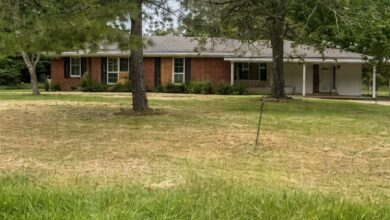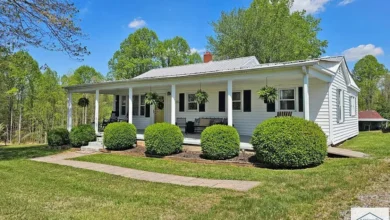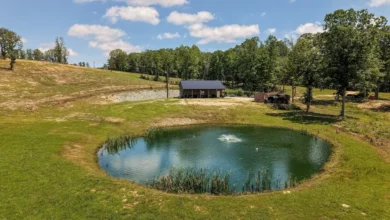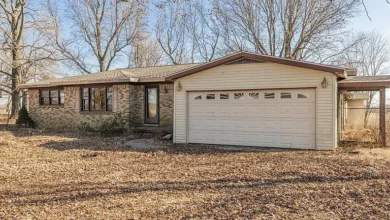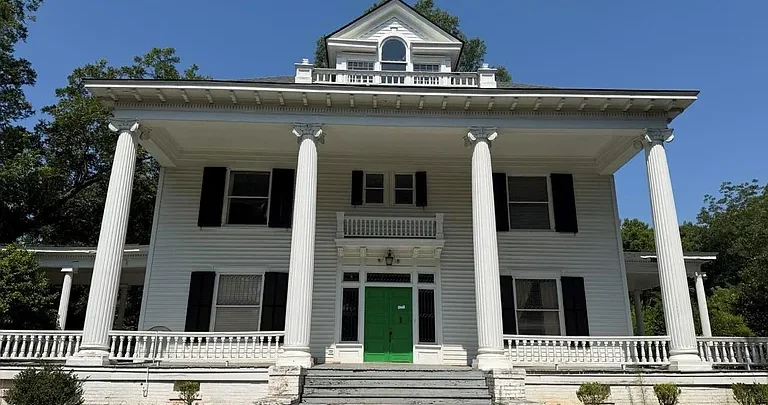
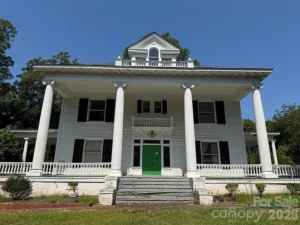
Every small Southern town has one house that everybody knows by name. In Wadesboro, North Carolina, that house is the Rose Home — a two-story colonial built in 1908, sitting on just over an acre at the end of a quiet terrace, with the kind of grand staircase and high ceilings that simply are not built anymore.
It is now on the market at three hundred fifty thousand dollars. For four thousand one hundred square feet, that works out to roughly eighty-five dollars per square foot. In a country where the median existing-home price hovers around four hundred thousand dollars for far less space, that number stops people mid-scroll.
A House with a Name and a Century Behind It
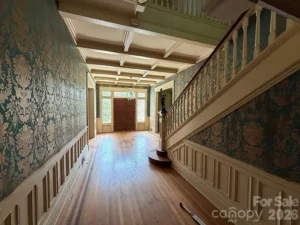
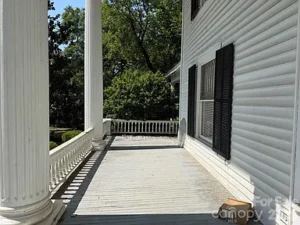
Built in 1908, the Rose Home has stood through two world wars, the Great Depression, the collapse and rebirth of the Carolina textile economy, and more than a hundred Anson County summers. It is a full two-story colonial in wood and vinyl, and the listing describes exactly the features that draw preservation-minded buyers: original hardwood floors, high ceilings, generously proportioned rooms, a grand staircase, and old-world craftsmanship throughout.
Those phrases mean something specific in a home of this vintage. Hardwood from 1908 was cut from old-growth timber — tighter grain, denser, and more dimensionally stable than anything milled today. High ceilings were a passive cooling strategy long before air conditioning existed, and they are the single feature most responsible for making a room feel grand rather than merely large. A grand staircase, executed by hand in the early twentieth century, is effectively irreplaceable at any reasonable cost.
Inside: Four Thousand Square Feet of Flexible Living
Property records list five bedrooms and five bathrooms, while the listing describes the layout as four bedrooms with four and a half baths. Either way, the practical takeaway is the same: this is an enormous house with far more bathrooms than a home of its era would originally have had, meaning significant plumbing work has already been done by previous owners.
The standout layout feature is dual primary suites. Buyers get primary bedroom and bathroom options on both the main level and the upper floor. That single detail unlocks several living arrangements that most historic homes cannot accommodate:
- Multigenerational living, with aging parents on the main floor and no stairs to climb
- Accessibility planning for buyers thinking about the next thirty years, not just the next three
- A private guest wing for extended family visits
- A separated suite that could be converted for rental or bed-and-breakfast use, subject to local rules
The kitchen has been updated and, per the listing, includes all appliances. Comfort systems are modern as well: a heat pump handles heating and central air handles cooling, which is genuinely rare in houses of this age. Many 1908 homes still limp along on radiators and window units. A functioning heat pump with ducted central air removes one of the most expensive line items from any historic renovation budget.
There is a dedicated laundry room, a driveway with uncovered parking, and no basement — the home is fully above grade with all four thousand one hundred square feet counted as finished living space.
The Lot: Over an Acre Inside Town Limits
The parcel measures one and eight hundredths acres and sits in the Homeplace area of Wadesboro under R10 residential zoning. That combination — more than an acre of land while still on city water and public sewer — is unusual and valuable.
Buyers get the space for gardens, mature shade trees, a workshop, or a detached garage, without the well and septic maintenance obligations that come with true rural acreage. Municipal water and sewer also simplify financing and insurance, since lenders and carriers treat them as lower risk than private systems.
Wadesboro Elementary School is roughly three tenths of a mile away, close enough to walk. The town itself is the county seat of Anson County, positioned along the US 74 corridor within about an hour’s drive of Charlotte — near enough for occasional commuting or a day trip, far enough that land still costs what land used to cost.
The Price Story: Why This Number Is Worth Studying
This home did not arrive at three hundred fifty thousand dollars by accident. The price history tells a clear story. It first came to market in May of 2025 at four hundred fifty thousand dollars. Over the following months it stepped down to four hundred twenty-five thousand, then four hundred ten thousand, then three hundred seventy-five thousand, before the listing was withdrawn and relaunched at the current asking price.
Cumulatively, this property has spent more than four hundred days on the market. Meanwhile, the automated valuation estimate sits at approximately three hundred fifty-three thousand six hundred dollars, with an estimated range running from roughly three hundred thirty-six thousand to three hundred seventy-one thousand.
In other words, the seller has now priced at or slightly below the algorithmic estimate after a full year of resistance. For a buyer, that is a meaningful signal. Long market exposure combined with repeated reductions typically indicates motivation.
The Notice of Default: What It Actually Means
The property record carries a special condition worth understanding clearly: a Notice of Default. This is the formal filing that begins the foreclosure process in North Carolina when a borrower falls behind on mortgage payments. It does not mean the home has been foreclosed on, and it does not mean the sale is invalid. It means the clock is running.
Buyers should understand the practical implications:
- Timelines can compress. A seller in default is usually working against a scheduled trustee sale date, which can make a clean, well-documented offer more attractive than a marginally higher one with contingencies.
- Lender approval may be involved. If the sale price does not fully satisfy the outstanding loan balance, the transaction becomes a short sale, which requires lender sign-off and can extend closing dramatically.
- Title work is non-negotiable. A full title search and owner’s title insurance policy are essential. Properties in default frequently carry additional liens for unpaid taxes, contractor work, or judgments.
- Condition disclosures may be limited. Distressed sellers often have deferred maintenance and sometimes provide reduced disclosure. Independent inspection becomes the buyer’s only real protection.
None of this is a reason to walk away. Some of the best value in American real estate sits in exactly these situations. It is a reason to work with an experienced buyer’s agent and a real estate attorney from the very first conversation.
Financing a Century-Old Home
Because the home has functioning modern systems, standard financing is realistic here. Buyers generally have several routes worth comparing:
- Conventional financing for buyers with strong credit, typically requiring five to twenty percent down, with private mortgage insurance below twenty percent
- An FHA loan with a lower down payment threshold, provided the property passes minimum condition standards on appraisal
- A USDA loan, which is worth checking here — much of rural Anson County falls inside USDA eligible mapping, and this program allows zero down payment for qualifying buyers within income limits
- An FHA 203k or Fannie Mae HomeStyle renovation loan, which folds the purchase price and a renovation budget into a single mortgage — the natural fit for anyone planning to restore original details
- A VA loan for eligible service members and veterans, also with no down payment requirement
One additional angle deserves attention: North Carolina offers a state historic rehabilitation tax credit for qualifying income-producing and owner-occupied historic structures. Eligibility depends on listing status and the nature of the work performed, so buyers planning substantial restoration should contact the North Carolina State Historic Preservation Office before starting any project. Ordering work in the wrong sequence can forfeit credits worth tens of thousands of dollars.
Carrying Costs and Insurance
The most recent annual property tax bill on this parcel was one thousand six hundred thirty-eight dollars against an assessed value of two hundred twenty-two thousand nine hundred dollars. For a four thousand square foot home on an acre, that is remarkably low. Expect reassessment following a sale at a higher price.
Homeowners insurance is where older homes demand attention. Carriers price policies based on replacement cost, and replacing hand-milled millwork and plaster is expensive. Buyers should request quotes early and specifically ask about:
- Whether the policy offers guaranteed replacement cost or actual cash value
- Whether ordinance and law coverage is included, which pays to bring rebuilt sections up to current code
- Documentation requirements for electrical, plumbing, roof, and heating system ages
- Water backup and service line endorsements, which are inexpensive and highly relevant on century-old sewer connections
Income Potential
Rental estimates for this address run in the range of twenty-five hundred dollars per month. With dual primary suites and four thousand square feet, the property also supports more creative approaches — a partial house-hack arrangement, a licensed bed-and-breakfast, or a small event and photography venue, each subject to Anson County and Wadesboro zoning approval under the existing R10 designation. Verify permitted uses in writing before you count on any of it.
The Inspection List for a 1908 House
- Full electrical evaluation, checking for any remaining knob and tube or cloth-insulated wiring
- Lead-based paint and asbestos testing, standard for anything built before 1978
- Sewer line camera scope from the house to the municipal main
- Foundation, sill plate, and floor framing assessment
- Roof age and remaining service life
- Heat pump age, refrigerant type, and ductwork condition
- Window survey, distinguishing restorable originals from failed replacements
- Comprehensive title search with owner’s title insurance
The Bottom Line
The Rose Home is not a flip and it is not a starter house. It is four thousand one hundred square feet of genuine early-twentieth-century American architecture on an acre of town land, offered at a price that reflects a motivated situation rather than a market judgment on the house itself.
For a buyer with vision, patience, and a good attorney, houses like this are how real generational wealth quietly gets built — one grand staircase at a time.
-
-
-
-
-
-
-
-
-
-
-
-
-
From ZILLOW